

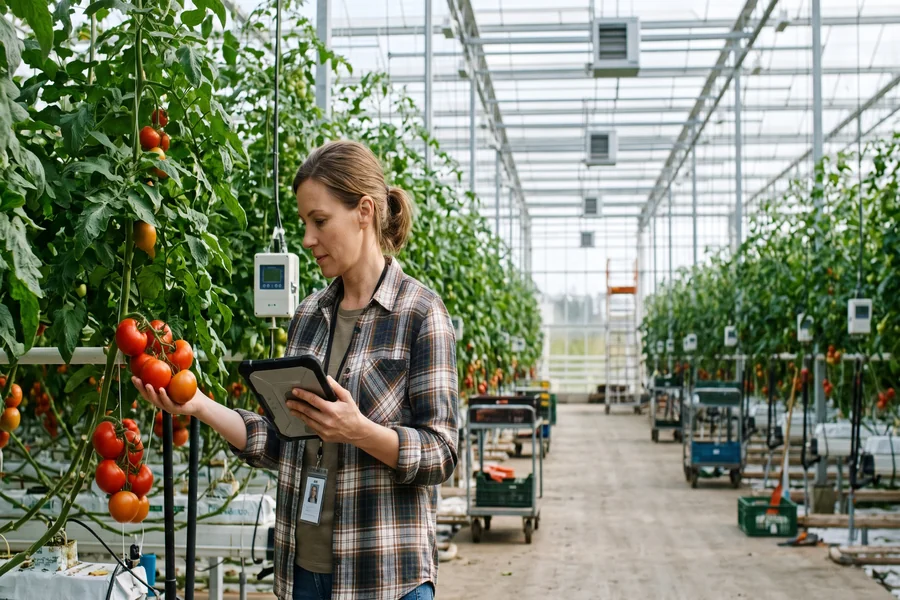
The tomato you bought this week is the result of decisions made eight to twelve years ago. Developing a new commercial variety of tomato, wheat or melon is one of the longest and most expensive processes in modern agriculture, a full decade of crosses, field trials, selections and rejections that ends with a single commercial variety emerging from thousands of candidates. A single breeding program costs millions of dollars to run, and every year cut from that timeline is worth real money to the seed company and to the farmers waiting for a variety that resists disease better, drinks less water and holds longer on the shelf. Over the past decade this process has moved from the notebook and the pencil to software, and the person who manages a breeding program today is really managing a large and growing database of genetics and field observations.
What actually happens during those years
A classical breeding program works in generations. Breeders start with parents, one variety that yields well but is susceptible to a disease, another that resists the disease but yields poorly, cross them, and select the best offspring in every generation. The problem is arithmetic: each generation takes a full growing season, six to eight years of crossing and selection are needed just to stabilize a line, and then come years of multi-location testing before the variety can be registered and sold. Along the way thousands of plants are evaluated every season, and every plant is measured on dozens of traits, yield, sugar content, disease resistance, fruit shape, shelf life, maturity date. In the era of paper notebooks and scattered spreadsheets, much of that information was simply lost, and every new season started with only part of the accumulated knowledge. The software era changed the question breeders ask from what happened in this plot to what the whole program knows.
Where the data changes the math
| Parameter | Traditional breeding | Data-driven breeding |
| Cycles per year | One to two | Three or more with off-season nurseries |
| Data management | Notebooks and spreadsheets | One central database |
| Parent selection | Experience and intuition | Prediction models |
| Chance of missing a winner | High | Significantly lower |
| Program knowledge | Lives in people | Lives in the system |
The table hides the quiet revolution in its second row. Off-season nurseries, greenhouses and winter nurseries in the opposite hemisphere, have existed for decades, but coordinating them with a scattered data trail was so costly that most programs did not fully use them. When every cross, every plot and every observation lives in one place, a program can realistically run three generations a year instead of one, and eight to twelve years starts to compress toward six or seven.
Genomic selection, in plain terms
The method that does the heaviest lifting is called genomic selection. Instead of waiting for seedlings to grow up and reveal themselves in the field, breeders take a leaf sample at the seedling stage, read its genetic makeup through molecular markers, and predict, based on thousands of previously measured offspring, which seedlings deserve space in the field and which do not. The prediction is only as good as the historical data behind it, which is why unified breeding platforms have become the operating layer of modern programs. Phenome Networks, the breeding platform built by Phenome Networks, unifies field observations from thousands of plots per season with genotyping results and crossing plans, and serves breeding programs in dozens of countries. The saving arrives from two directions at once: less field space wasted on weak candidates, and more cycles per year, which is the compound interest of plant breeding.
What happens to all the data
One field trial produces thousands of records in a single season, and each record carries dozens of fields, plot number, trial site, soil type, irrigation regime, planting date, and every measurement taken through the season. When that history is preserved in a central system, an experiment run seven years ago in a different region can still feed today’s prediction models, and the program’s knowledge stops walking out the door when a breeder retires or a project moves continents. Teams feed the same system from the field, from the phone or the tablet, and the database becomes shared property rather than personal memory. For companies that measure pipelines in decades, that continuity is the asset; algorithms can be replaced, data cannot be regrown.
The rules that govern the finish line
A variety that performs well in trials still has one gate to pass before it can be sold as a commercial variety. Under the international system administered by UPOV, the intergovernmental body that grants plant breeders’ rights, a new variety must demonstrate Distinctness, Uniformity and Stability, the DUS test, typically examined over two independent growing cycles before protection is granted. That requirement explains part of the timeline’s stubborn length, and it also explains why data discipline matters to the very end: the same records that guided selection become the evidence base for registration. A program that knows exactly where every observation came from reaches the finish line with its paperwork already in order.
Who wins and when
The varieties being developed with these tools today are aimed at the problems of the coming decade, tomatoes that hold a week longer on the shelf and cut food waste, wheat lines that manage with less water, beans that tolerate the heat profile of a new kind of summer. For seed companies the calculation is simple: a program that runs three cycles a year instead of one reaches the market years before its competitors, and in an era of shifting climate zones those years translate into market share. The seed that will feed the world twenty years from now is passing, right now, through the first cross of its generation, somewhere between a field of candidates and a prediction model that decided it was worth the space.